5 Things Rust Cheats Actually Change In Your Gameplay
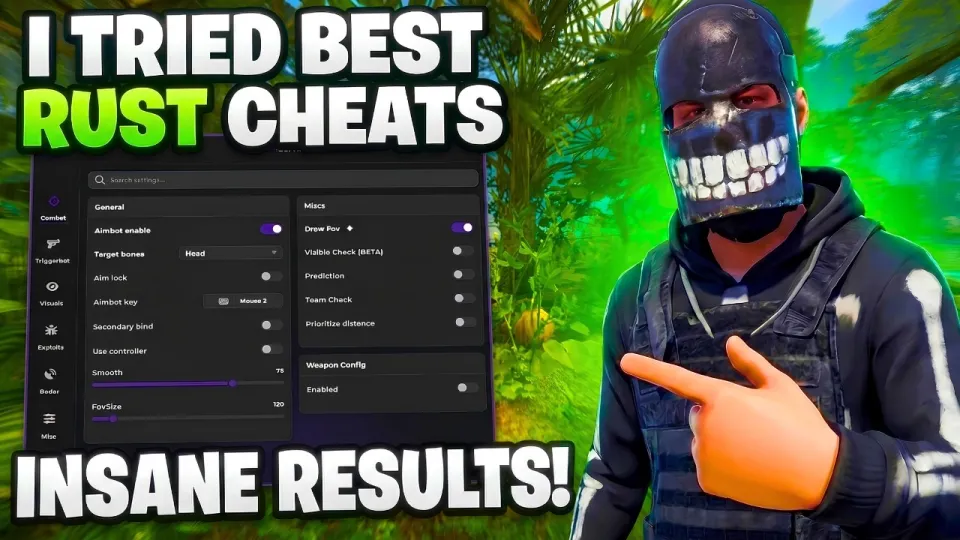
Video: I Secretly Used Rust Cheat To Dominate Everyone In The Server...(INSANE)
Key takeaways
- The featured package is the ZALIANT Private Rust Cheat, sold through zaliantservices.com with a dedicated Discord server.
- A typical Rust cheat menu covers ESP and wallhack, aimbot and silent aim, recoil and spread control, and movement or farming helpers.
- Rust runs Facepunch's Easy Anti-Cheat plus server-side and manual moderation, so any cheat carries a permanent ban risk.
- Private cheat subscriptions are usually priced per month or per key, and buyers get loader updates after game patches.
- The showcase video from channel yqzkqrv walks through the menu, settings and in-game footage in roughly a minute.
Rust cheats are third-party software packages that inject an overlay into the game client to add information and automation the vanilla game does not provide — most commonly player ESP, aimbot and recoil control. The package featured in the recent showcase is the ZALIANT Private Rust Cheat, which ships a loader, an in-game menu and configurable settings for each module. Everything below explains what those modules actually do, how a session with them plays out, and what the risks are.
What a Rust cheat menu contains in practice
A Rust cheat menu is an overlay opened with a hotkey that groups every module into tabs, and the layout of most private packages follows the same pattern. The showcase from yqzkqrv opens on the menu itself before moving into gameplay, and the structure is representative of the category:
- Visuals (ESP/wallhack). Player boxes, names, distance readouts, health and team indicators drawn through walls, plus loot, crate, stash and sleeping-bag markers.
- Combat (aimbot/silent aim). Target selection by field of view, hitbox priority (head, chest, nearest bone), smoothing sliders and visibility checks so the aim only locks on players you could plausibly see.
- Weapon control. Recoil compensation and spread reduction, usually split per gun so an AK pattern and an MP5 pattern can be tuned separately.
- Utility. Fast farm helpers, instant craft or queue shortcuts, no-fall damage, speed modifiers and building helpers.
- Interface options. Config saving and loading, stream-proof overlay toggles and per-module keybinds.
Private packages differ from free ones mainly in update cadence: when Facepunch patches the client, the loader needs a new build, and paid users get it first.
How ESP and aimbot change a wipe
ESP and aimbot change the information balance of a wipe, which matters more in Rust than in a round-based shooter. Rust punishes uncertainty: you lose kits to a player crouched behind a rock, to a counter-raid you did not see coming, or to a crate you walked past. Wallhack-style visuals remove that uncertainty — you know which base has an online defender, which monument is being farmed and where the airdrop landed relative to other groups.
Aimbot changes the other half: the fight itself. In Rust, most gunfights are decided by recoil control and first-shot accuracy at 80–200 meters, and a scripted recoil pattern plus a smoothed aim lock collapses that skill gap. In the showcase footage the aim adjustments are subtle rather than snapping, which is the whole point of a "legit" configuration — the goal is to look like a strong player rather than an obvious one.
Settings that separate a usable config from a banned account
Configuration is the part that decides whether a cheat survives a wipe, and the settings that matter most are the ones that keep your behaviour looking human. Practical defaults experienced users apply:
- FOV limits. Keep the aimbot field of view tight (a few degrees) so the crosshair only assists near where you are already aiming.
- Smoothing. Higher smoothing values slow the lock-on; instant snapping is the single most reported behaviour.
- Bone priority. Chest or nearest-bone targeting looks less mechanical than permanent head locking.
- Visibility checks. Only assist on targets that are actually rendered to you, not through walls.
- Toggle, not hold. Bind modules to keys you press situationally instead of leaving them permanently on.
- Stream-proof overlay. Hides the menu from capture software if you record or stream.
None of these make cheating safe — they only reduce how obvious it is to other players and to server admins reviewing clips.
Anti-cheat and ban risk in Rust
Rust is protected by Easy Anti-Cheat on the client, backed by server-side detection and manual moderation on official and community servers, and every cheat carries a permanent ban risk. Facepunch bans are applied to the game account and, in serious cases, linked accounts; community servers run their own admin teams who review reports and footage. The realistic risk profile looks like this:
- Signature detection after a game or anti-cheat update, which is why loaders need constant recompilation.
- Behavioural detection from stats — impossible headshot ratios, pre-firing through walls, tracking players behind terrain.
- Player reports, which on high-pop servers are acted on within hours during peak play.
- Manual review of clips posted to community Discord servers and forums.
A private subscription buys update speed and support, not immunity. Anyone telling you a Rust cheat is fully undetected is describing a moment in time, not a guarantee.
Cost, delivery and support for private Rust cheats
The commercial side of private Rust cheats is simple: a monthly subscription or a key-based purchase, a loader download, and a Discord server for support and patch announcements. Pricing across the market typically runs from roughly $10–15 per month for shared packages up to $30–50 for private ones with limited user counts, though exact figures change and should be checked on the seller's page.
What you are paying for is maintenance: after every Rust patch the offsets change, and a private package is expected to be back online within hours rather than days. Support channels matter as much as the feature list — a Discord where staff answer loader errors and post status updates is the difference between a usable month and a dead subscription.
Where to find the showcased package and community
All official links for the package shown in the video are collected here, exactly as published by the creator:
- Product page (ZALIANT Private Rust Cheat): https://www.zaliantservices.com/products/rustprivate
- Store front: https://www.zaliantservices.com
- Discord community: https://discord.gg/zaliant
Use these rather than reuploaded loaders from third-party sites; repacked cheat files are a common vector for malware and account theft.
Final take on the Rust cheat showcase
The video from channel yqzkqrv is a compact walkthrough — menu, feature overview, gameplay and a closing verdict in about a minute — and it is most useful as a look at how a modern private Rust cheat menu is organised rather than as proof of safety. The modules it demonstrates (ESP, aimbot, recoil control, utility) are the standard set for the category in 2026, and the configuration advice above applies to any of them. If you want to examine the package directly, start at the ZALIANT Private Rust Cheat product page and read the current status and pricing before subscribing. Weigh the permanent ban risk against the advantage, because on Rust the account you lose carries every wipe you have played on it.
Questions & answers
What are Rust cheats and what do they include?
Rust cheats are third-party overlays injected into the game client that add information and automation. A typical package includes player and loot ESP, aimbot with configurable smoothing and FOV, recoil and spread control, and utility modules such as farm or movement helpers, all managed from an in-game menu.
Are Rust cheats undetected?
No cheat can honestly be called permanently undetected. Rust uses Easy Anti-Cheat plus server-side detection and manual moderation, and every game or anti-cheat patch can flag existing builds. Private packages survive longer because they are updated quickly, but a ban risk always remains.
How much do private Rust cheats cost?
Private packages are usually sold as monthly subscriptions or keys. Across the market that generally means around $10–15 per month for shared cheats and $30–50 for genuinely private ones with limited user counts, with the exact price set by the seller and subject to change.
What settings make a Rust cheat config less obvious?
Keep the aimbot FOV narrow, raise smoothing so the aim does not snap, target the chest or nearest bone instead of always the head, enable visibility checks, and bind modules to toggle keys rather than leaving them on. These reduce how mechanical your gameplay looks but do not remove detection risk.
Source: I Secretly Used Rust Cheat To Dominate Everyone In The Server...(INSANE) · Markdown version